Brand Name
Kalbitor
Generic Name
Ecallantide
View Brand Information FDA approval date: February 02, 2010
Classification: Plasma Kallikrein Inhibitor
Form: Injection
What is Kalbitor (Ecallantide)?
KALBITOR ® is indicated for treatment of acute attacks of hereditary angioedema in patients 12 years of age and older. KALBITOR is a plasma kallikrein inhibitor indicated for treatment of acute attacks of hereditary angioedema in patients 12 years of age and older.
Approved To Treat
Save this treatment for later
Not sure about your diagnosis?
Tired of the same old research?
Related Clinical Trials
There is no clinical trials being done for this treatment
Related Latest Advances
Brand Information
Kalbitor (Ecallantide)
WARNING: ANAPHYLAXIS
Anaphylaxis has been reported after administration of KALBITOR. Because of the risk of anaphylaxis, KALBITOR should only be administered by a healthcare professional with appropriate medical support to manage anaphylaxis and hereditary angioedema. Healthcare professionals should be aware of the similarity of symptoms between hypersensitivity reactions and hereditary angioedema and patients should be monitored closely. Do not administer KALBITOR to patients with known clinical hypersensitivity to KALBITOR. [
1INDICATIONS AND USAGE
KALBITOR
2DOSAGE FORMS AND STRENGTHS
KALBITOR is a clear, colorless liquid free of preservatives. Each vial of KALBITOR contains ecallantide at a concentration of 10 mg/mL.
3CONTRAINDICATIONS
Do not administer KALBITOR to a patient who has known clinical hypersensitivity to KALBITOR. [
4ADVERSE REACTIONS
Hypersensitivity reactions, including anaphylaxis, have occurred in patients treated with KALBITOR [
4.1Clinical Trials Experience
Because clinical trials are conducted under widely varying conditions, adverse reaction rates observed in the clinical trials of a drug cannot be directly compared to rates in the clinical trials of another drug and may not reflect the rates observed in practice.
The safety data described below reflect exposure to KALBITOR in 255 patients with HAE treated with either intravenous or subcutaneous KALBITOR. Of the 255 patients, 66% of patients were female and 86% were Caucasian. Patients treated with KALBITOR were between the ages of 10 and 78 years.
Overall, the most common adverse reactions in 255 patients with HAE were headache (16%), nausea (13%), fatigue (12%), diarrhea (11%), upper respiratory tract infection (8%), injection site reactions (7%), nasopharyngitis (6%), vomiting (6%), pruritus (5%), upper abdominal pain (5%), and pyrexia (5%).
Anaphylaxis was reported in 4% of patients with HAE. Injection site reactions were characterized by local pruritus, erythema, pain, irritation, urticaria, and/or bruising.
The incidence of adverse reactions below is based upon 2 placebo-controlled, clinical trials (EDEMA3
Some patients in EDEMA3 and EDEMA4 received a second, open-label 30 mg subcutaneous dose of KALBITOR within 24 hours following the initial dose. Adverse reactions reported by these patients who received the additional 30 mg subcutaneous dose of KALBITOR were consistent with those reported in the patients receiving a single dose.
4.2Immunogenicity
In the KALBITOR HAE program, patients developed antibodies to KALBITOR. Rates of seroconversion increased with exposure to KALBITOR over time. Overall, 20.2% of patients seroconverted to anti-ecallantide antibodies. Neutralizing antibodies to ecallantide were determined
Anti-ecallantide IgE antibodies were detected at a rate of 4.7% for tested patients, and anti-
The test results for the ecallantide program were determined using one of two assay formats: ELISA and bridging electrochemiluminescence (ECL). As with all therapeutic proteins, there is a potential for immunogenicity with the use of KALBITOR. The incidence of antibody formation is highly dependent on the sensitivity and specificity of the assay. Additionally, the observed incidence of antibody (including neutralizing antibody) positivity in an assay may be influenced by several factors, including assay methodology, sample handling, timing of sample collection, concomitant medications, and underlying disease. For these reasons, comparison of the incidence of antibodies to KALBITOR with the incidence of antibodies to other products may be misleading.
4.3Postmarketing Experience
Similar adverse reactions have been observed postmarketing as described for clinical trial experience. Because these events are reported voluntarily from a population of uncertain size, it is not always possible to reliably estimate frequency or to establish a causal relationship with drug exposure.
5DRUG INTERACTIONS
No formal drug interactions studies were performed. No
6OVERDOSAGE
There have been no reports of overdose with KALBITOR. HAE patients have received single doses up to 90 mg intravenously without evidence of dose-related toxicity.
7DESCRIPTION
KALBITOR (ecallantide) is a human plasma kallikrein inhibitor for injection for subcutaneous use. Ecallantide is a 60-amino-acid protein produced in
KALBITOR is a clear and colorless, sterile, and nonpyrogenic solution. Each vial contains 10 mg ecallantide as the active ingredient, and the following inactive ingredients: 0.76 mg disodium hydrogen orthophosphate (dihydrate), 0.2 mg monopotassium phosphate, 0.2 mg potassium chloride, and 8 mg sodium chloride in water for injection, USP. KALBITOR is preservative free, with a pH of approximately 7.0. A 30 mg dose is supplied as 3 vials each containing 1 mL of 10 mg/mL KALBITOR. Vials are intended for single use.
8CLINICAL STUDIES
The safety and efficacy of KALBITOR to treat acute attacks of hereditary angioedema in adolescents and adults were evaluated in 2 randomized, double-blind, placebo-controlled trials (EDEMA4 and EDEMA3) in 168 patients with HAE. Patients having an attack of hereditary angioedema, at any anatomic location, with at least 1 moderate or severe symptom, were treated with 30 mg subcutaneous KALBITOR or placebo. Because patients could participate in both trials, a total of 143 unique patients participated. Of the 143 patients, 94 were female, 123 were Caucasian, and the mean age was 36 years (range 11-77). There were 64 patients with abdominal attacks, 55 with peripheral attacks, and 24 with laryngeal attacks.
In both trials, the effects of KALBITOR were evaluated using the Mean Symptom Complex Severity (MSCS) score and the Treatment Outcome Score (TOS). These endpoints evaluated attack severity (MSCS) and patient response to treatment (TOS) for an acute HAE attack.
MSCS score is a point-in-time measure of symptom severity. At baseline, and post-dosing at 4 hours and 24 hours, patients rated the severity of each affected symptom on a categorical scale (0 = normal, 1 = mild, 2 = moderate, 3 = severe). Patient-reported severity was based on each patient's assessment of symptom impact on their ability to perform routine activities. Ratings were averaged to obtain the MSCS score. The endpoint was reported as the change in MSCS score from baseline. A decrease in MSCS score reflected an improvement in symptom severity; the maximum possible change toward improvement was -3.
TOS is a measure of symptom response to treatment. At 4 hours and 24 hours post-dosing, patient assessment of response for each anatomic site of attack involvement was recorded on a categorical scale (significant improvement [100], improvement [50], same [0], worsening [-50], significant worsening [-100]). The response at each anatomic site was weighted by baseline severity and then the weighted scores across all involved sites were averaged to calculate the TOS. A TOS value >0 reflected an improvement in symptoms from baseline. The maximum possible score was +100.
9HOW SUPPLIED/STORAGE AND HANDLING
KALBITOR (ecallantide) is supplied as three 10 mg/mL single-dose vials packaged in a carton. Each vial contains 10 mg of ecallantide. Each vial contains a slight overfill.
- NDC (47783-101-01): 3 single-dose vials in 1 carton
10PATIENT COUNSELING INFORMATION
See
- Advise patients that KALBITOR may cause anaphylaxis and other hypersensitivity reactions. Advise patients that KALBITOR should be administered by a healthcare professional with appropriate medical support to manage anaphylaxis and hereditary angioedema. Instruct patients who have known clinical hypersensitivity to KALBITOR not to receive additional doses of KALBITOR. [
- Advise patients to consult the Medication Guide for additional information regarding the risk of anaphylaxis and other hypersensitivity reactions.
For more information, visit www.kalbitor.com or call 1-877-TAKEDA-7 (1-877-825-3327).
11Medication Guide
KALBITOR
Read this Medication Guide before you start receiving KALBITOR and before each treatment. There may be new information. This Medication Guide does not take the place of talking to your doctor about your medical condition or your treatment.
What is the most important information that I should know about KALBITOR?
Serious allergic reactions may happen in some people who receive KALBITOR. These allergic reactions can be life-threatening and usually happen within 1 hour after receiving KALBITOR.
- KALBITOR should be given to you by a doctor or nurse in a healthcare setting where serious allergic reactions and hereditary angioedema (HAE) can be treated.
- Symptoms of a serious allergic reaction to KALBITOR can be similar to the symptoms of HAE, the condition that you are being treated for. Your doctor or nurse should watch you for any signs of a serious allergic reaction after treatment with KALBITOR.
- Tell your doctor or nurse right away if you have any of these symptoms of a serious allergic reaction during or after treatment with KALBITOR:
- wheezing, shortness of breath, cough, chest tightness, or trouble breathing
- dizziness, fainting, fast or weak heartbeat, or feeling nervous
- reddening of the face, itching, hives, or feeling warm
- swelling of the throat or tongue, throat tightness, hoarse voice, or trouble swallowing
- runny nose, nasal congestion, or sneezing
What is KALBITOR?
KALBITOR is a prescription medicine used to treat sudden attacks of hereditary angioedema (HAE) in people 12 years of age and older.
KALBITOR is not a cure for HAE.
It is not known if KALBITOR is safe and effective in children under 12 years of age.
Who should not receive KALBITOR?
Do not receive KALBITOR if you are allergic to KALBITOR.
What should I tell my doctor before I receive KALBITOR?
Before receiving KALBITOR, tell your doctor if you:
- have ever had an allergic reaction to KALBITOR. See "
- are pregnant or plan to become pregnant. It is not known if KALBITOR will harm your unborn baby.
- are breast-feeding or plan to breast-feed. It is not known if KALBITOR passes into your breast milk.
Tell your doctor about all the medicines you take, including prescription and over-the-counter medicines, vitamins, and herbal supplements.
Know the medicines you take. Keep a list of them to show to your doctor and pharmacist when you get a new medicine.
How will I receive KALBITOR?
For each dose, you will receive 3 injections just under the skin (subcutaneous or SC injections) of your abdomen, thigh, or upper arm.
What are the possible side effects?
KALBITOR can cause serious allergic reactions. See "What is the most important information I should know about KALBITOR?"
Common side effects of KALBITOR include:
- headache
- nausea
- diarrhea
- fever
- injection site reactions, such as redness, rash, swelling, itching, or bruising
- stuffy nose
Call your doctor for advice about side effects. You may report side effects to FDA at 1-800-FDA-1088.
General information about KALBITOR
Medicines are sometimes prescribed for purposes other than those listed in a Medication Guide. This Medication Guide gives you the most important information about KALBITOR. If you would like more information, talk with your doctor. You can ask your pharmacist or doctor for information about KALBITOR that is written for health professionals.
What are the ingredients of KALBITOR?
Active Ingredient: ecallantide
Inactive ingredients: disodium hydrogen orthophosphate (dihydrate), monopotassium phosphate, potassium chloride, sodium chloride in water for injection.
This Medication Guide has been approved by the U.S. Food and Drug Administration.
For more information, visit www.kalbitor.com or call 1-877-TAKEDA-7 (1-877-825-3327).
Manufactured by:
U.S. License No. 1898
KALBITOR and the KALBITOR Logo are registered trademarks of Dyax Corp.
Takeda and
© 2025 Takeda Pharmaceuticals U.S.A., Inc. All rights reserved.
Revised: 6/2025
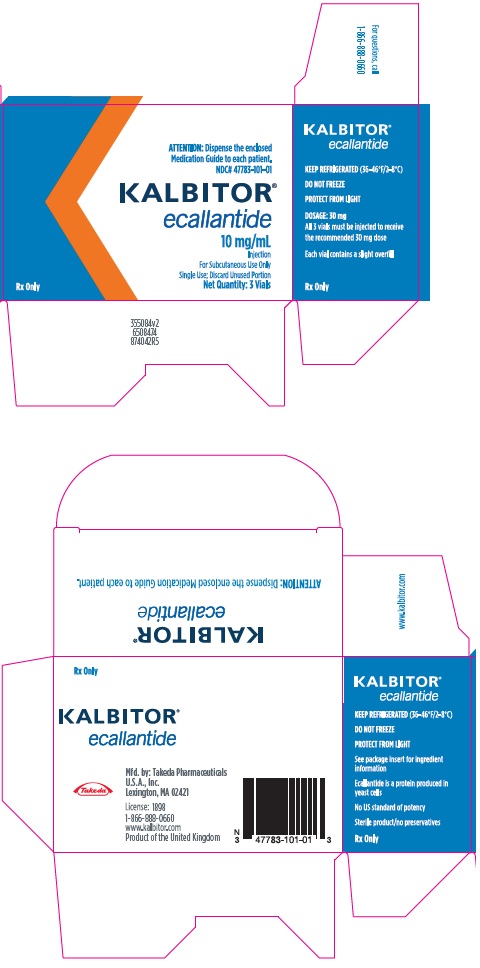
12PRINCIPAL DISPLAY PANEL - 10 mg/mL Vial Carton
ATTENTION: Dispense the enclosed
KALBITOR®
ecallantide
10 mg/mL
Injection
For Subcutaneous Use Only
Single-Dose ;Discard Unused Portion
Net Quantity: 3 Vials
Injection
For Subcutaneous Use Only
Single-Dose ;Discard Unused Portion
Net Quantity: 3 Vials
Rx Only
13PRINCIPAL DISPLAY PANEL - 10 mg/mL Vial Bottle
NDC 47783-101-01
KALBITOR®
ecallantide
10 mg/mL
Single-Dose; Discard Unused Portion
Rx Only. For Subcutaneous Use Only.
Takeda Pharmaceuticals U.S.A., Inc.
Single-Dose; Discard Unused Portion
Rx Only. For Subcutaneous Use Only.
Takeda Pharmaceuticals U.S.A., Inc.
